
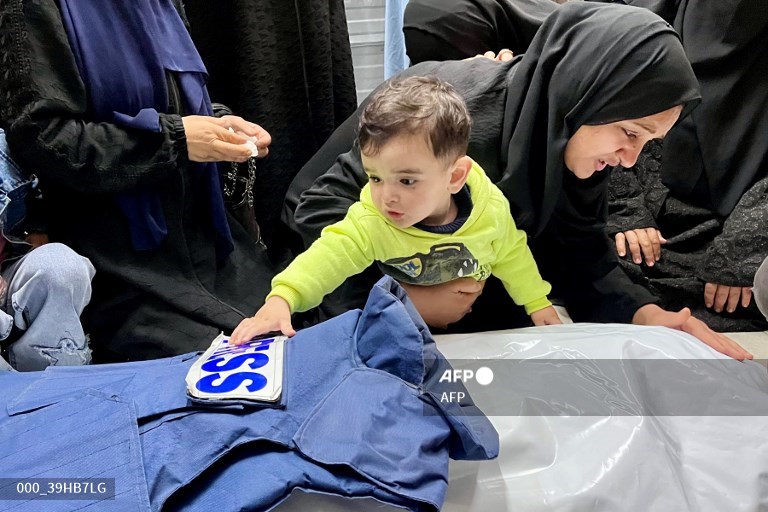
In September 2025, at least 31 journalists and media workers were killed when a missile struck a building housing two newsrooms in Sana’a. It was one of the largest single massacres of journalists in modern history. Outside Yemen, it barely registered.
Israel claimed it was targeting Houthi “military” and “propaganda” infrastructure. Journalists were folded into that definition. Despite the shocking loss of life, no urgent diplomatic rupture followed. There was no sustained international response. The killings were acknowledged, processed and absorbed. The news cycle quickly moved on.
This non-response to a massacre was far from an anomaly in 2025 which was one of the deadliest years since INSI began recording journalist deaths more than 20 years ago. Yet the killings, often targeted, disrupted nothing.
Throughout the year, journalists were killed in extraordinary numbers around the world - from Gaza to Ukraine, from Peru to Mexico, in Sudan, India and Iran. INSI’s Killing the Messenger 2025 report documents 168 journalists and media workers who died while doing their jobs.
Most were local reporters killed by missiles, drones or gunfire, many in countries not officially at war. They were not accidental casualties. Many were clearly identified as media workers. Their deaths were foreseeable, and in many cases preventable.
Gaza blatantly showed how many journalists could be killed without altering military conduct, diplomatic relations or media practice. KTM recorded 68 journalists and media workers killed in Palestine in 2025, many directly targeted by Israel.
When we put Gaza on the same graph as Iraq, Afghanistan, Syria and the Balkans and everything else shrank. Once deaths were adjusted for time, population and territory, Gaza shot up as a brutal outlier, a mountain of journalist killings unlike anything recorded in modern war. You can see the graphs on pages 21 and 23.
What made Gaza distinct was not the scale of the violence alone, but how efficiently it was absorbed. Accountability was deferred and responsibility will be diluted over time. A version of the story continues - just without the journalists who were reporting it.
Our report includes a dedicated investigation into the Sana’a newsroom strike by Laura Silvia Battaglia al-Jalal, a journalist with long-standing experience in Yemen who recently visited the destroyed building and spoke to those who survived. Her reporting brings us face-to-face with what the killing of journalists means - fewer journalists, and witnesses, makes controlling the narrative easier.
The erosion of international law, accelerated by Israel’s conduct in Gaza and reinforced by the Trump administration’s rejection of international legal norms, has further normalised the killing of journalists.Despite laws designed to protect journalists and mechanisms to investigate their deaths, those who died in 2025 lost their lives with near total impunity.
This report records the names and faces of all those killed in 2025 across conflicts, protests, criminal violence and political repression.
Each name marks more than a life lost. It marks an investigation that ended, a set of facts that will now be contested without evidence. The cumulative effect is not abstract. It reshapes what the world is able to know.
Including their photographs resists the final erasure that follows death: anonymity. These images restore their individuality, reminding us they were not interchangeable units in a dangerous profession but specific people removed from the public record.
There is no comfort to be found here. Courage does not compensate for the withdrawal of protection. Memory is no substitute for justice. Documentation does not equal accountability.
This report exists because forgetting has become the default. Remembering requires effort, choice and resistance - and this is exactly what is required of us all.
This normalisation described in this report is not irreversible but will not correct itself. It can be disrupted only through sustained effort, conscious choice and active resistance. We must document and preserve facts when they are under assault; prioritise accountability over convenience or alignment; and resist the growing pressure to accept exclusion, substitution and silence as the cost of doing business. Where these conditions are met - collectively, not sporadically - the tide could be forced to turn.
Governments must investigate, prosecute and punish the killing of journalists, or accept responsibility for enabling it. Media organisations must act together to force access, expose unlawful restrictions and refuse to amplify narratives produced where independent reporting is deliberately obstructed or made lethal.
International bodies must treat attacks on journalists as immediate warnings of wider civilian harm and respond with enforcement, not just “concern”.
Without effort, choice and resistance, the killing of journalists will continue to be absorbed, and lies will replace the truths journalists were killed for trying to establish.
Read Killing the Messenger 2025 here.