
There is a particular kind of violence in destroying a newsroom. It is not only the killing of people, nor even the obliteration of a building, but the deliberate erasure of memory and record of the slow, daily labour of bearing witness in a place where almost everything else has already been stripped away.
On 10 September 2025, that violence arrived in central Sana’a. A series of Israeli airstrikes struck the offices of the 26 September weekly newspaper, killing 31 journalists and media workers and injuring more than 130 others.
Among those killed was Amal Mohammed Ghaleb al-Manakhi. She was not a public figure. Her face does not appear in death notices, obscured in line with rules imposed by the Houthis who govern northern Yemen. But her life is remembered with precision by her aunt, Fatima al-Daemari, who also worked at the paper as a secretary.
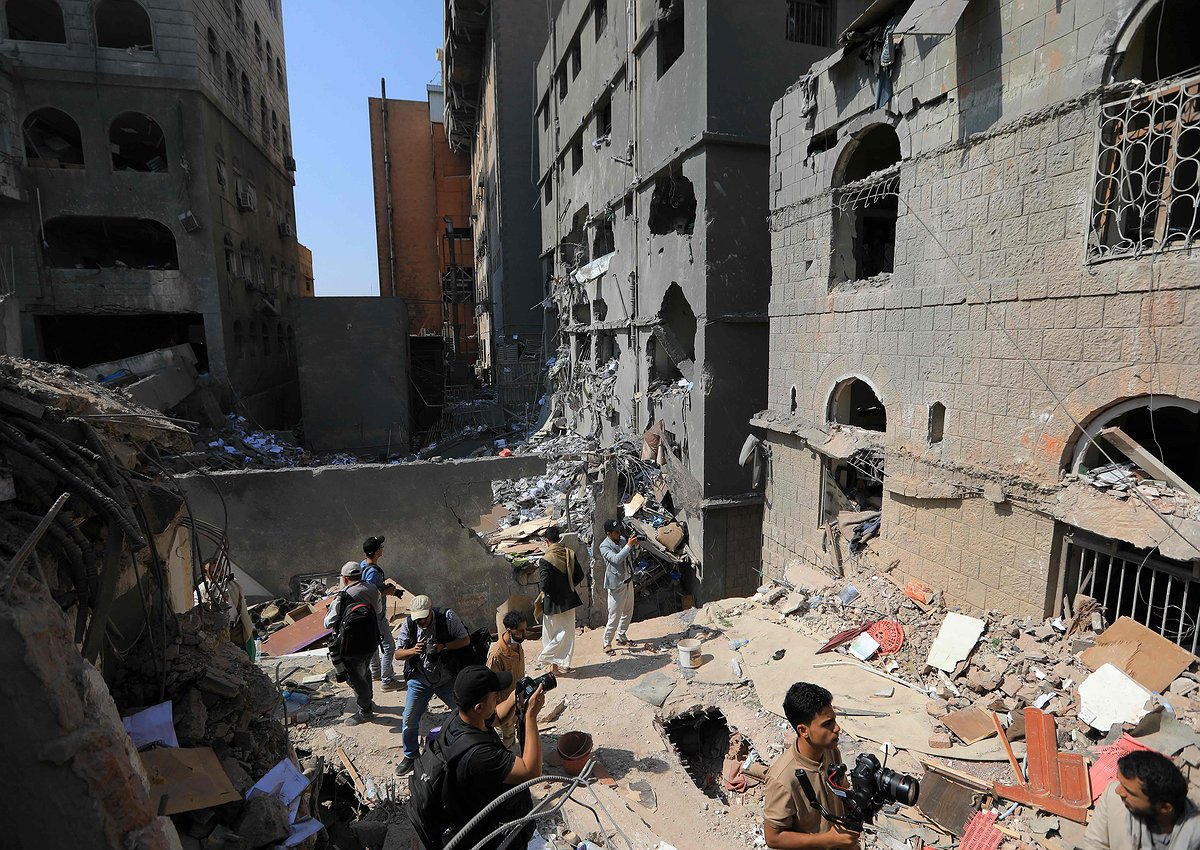
“I felt a great panic, fear and anxiety,” Fatima says, crying as she walks among the rubble of the government’s Moral Guidance Directorate headquarters in Sana’a, where the newspaper was based since its founding in 1990. “I called everyone. No one answered. I tried Amal. She didn’t answer.”
She describes leaving home immediately, pushing through traffic by bus, as smoke rose over the city, moving from the newspaper building to the military hospital, then from hospital to hospital across the capital. “We looked everywhere,” she says. “We didn’t find her.”
Fatima and Amal grew up in the same house. They later shared desks and deadlines. The newsroom was not simply a workplace but a shared life. Amal, she says, was diligent and generous, intent on improving her skills, always asking to be trained, always ready to help colleagues. Her ambition was simple and demanding at once: to do her work better, to learn, to progress.
The editor-in-chief of 26 September, Nassir al-Khodari, was at home that afternoon, preparing to leave for work. He lives around 500 metres from the office. “I heard a great explosion,” he says. At first, he assumed the building would be safe. “There were journalists there, cameras, equipment. We thought this place was safe.”
Then people in the street told him the target had been the newspaper itself. “I was shocked and ran quickly to the office,” he says. What he found no longer resembled a newsroom. “Everything was on the floor outside, rubble and papers. I saw people’s cars buried under the rubble.”
Witnesses and survivors, as well as videos documenting the immediate aftermath of the attack, show people thrown from shops and minibuses, bodies on fire, and others crushed by falling concrete. Smoke and fire were everywhere. It took a long time before the bodies and injured could be recovered, said a videographer who filmed the first images later released by news agencies and asked to remain anonymous.
Inside the building, al-Khodari recalls, phones rang unanswered. “We were searching, calling their phones, shouting their names,” he says. “We couldn’t find any survivors.” The destruction was total. “The place I used to work turned into a hole. It was a massacre.”
There is a tendency, when journalists are killed in war, to collapse their identities into the politics of the institutions they work for. As in previous cases in Gaza, Lebanon and Iran, Israel has repeatedly failed to distinguish between military targets and journalists, justifying killings by designating media workers as terrorists or propagandists. Under international humanitarian law, journalists are civilians protected from attack, including those working for state-run or armed group-affiliated outlets, unless they take a direct part in hostilities.
After the Houthi takeover of Sana’a in September 2014, 26 September became the official outlet of the Yemeni army and was produced and funded for a decade by the Houthi movement’s political wing, Ansar Allah. Its offices were seized along with much of the state.
On 10 September, the Israel Defense Forces confirmed the strikes, saying on X that they had hit “military targets” in Sana’a, including the “Houthi public relations department”, which it accused of distributing “psychological terror”.
But the people inside the building that day were not soldiers or combatants. They were editors, technicians and secretaries, people at desks, producing words under conditions few outsiders would be able to understand, let alone tolerate.
What burned alongside them was one of Yemen’s most important historical archives. The 26 September collection documented the country’s modern history across multiple eras, from the Qasimi state and Ottoman rule through monarchy, revolution and the decades that followed, including photographs, records of Yemen’s relations with neighbouring countries and documentation of international delegations and political visits. Much of it is now buried under rubble or reduced to ash. What remains is barely accessible, charred and incomplete.
“This archive was the history of a country,” al-Khodari says. “It was blown away,” scattered and destroyed by the explosion. ‘We weren’t able to save it.”
For those who survived, the destruction did not end with the blast. Al-Khodari describes journalists living with persistent fear and disorientation, unsure whether they are safe anywhere, at work or away from it. “They think they are being targeted at any moment,” he says. Some no longer carry mobile phones or avoid answering calls, afraid of being located. Others cannot return to the site at all. “They saw their colleagues die in front of them,” he adds. “That shock stays in the head. It does not leave.”
Al-Khodari does not mince his words. “Israeli bombs massacred 31 journalists in cold blood. And we have not heard a clear or firm condemnation, nothing that restores our trust that there are institutions that speak on our behalf.”
His anger is composed but profound. International law, he notes, is explicit: journalists are civilians and targeting them is a war crime. Yet the response has been silence, or close to it. “Spilling the blood of journalists has become permitted,” he says. “What justifies targeting journalists?”
For Fatima, the loss remains irreducibly personal. She remembers how Amal stayed with her after her mother died, refusing to let Fatima be alone. Now she walks through the rubble, trying to locate a desk that no longer exists. “She never left me,” she says. “I left her one day, and this is what happened. I can’t forgive myself.”